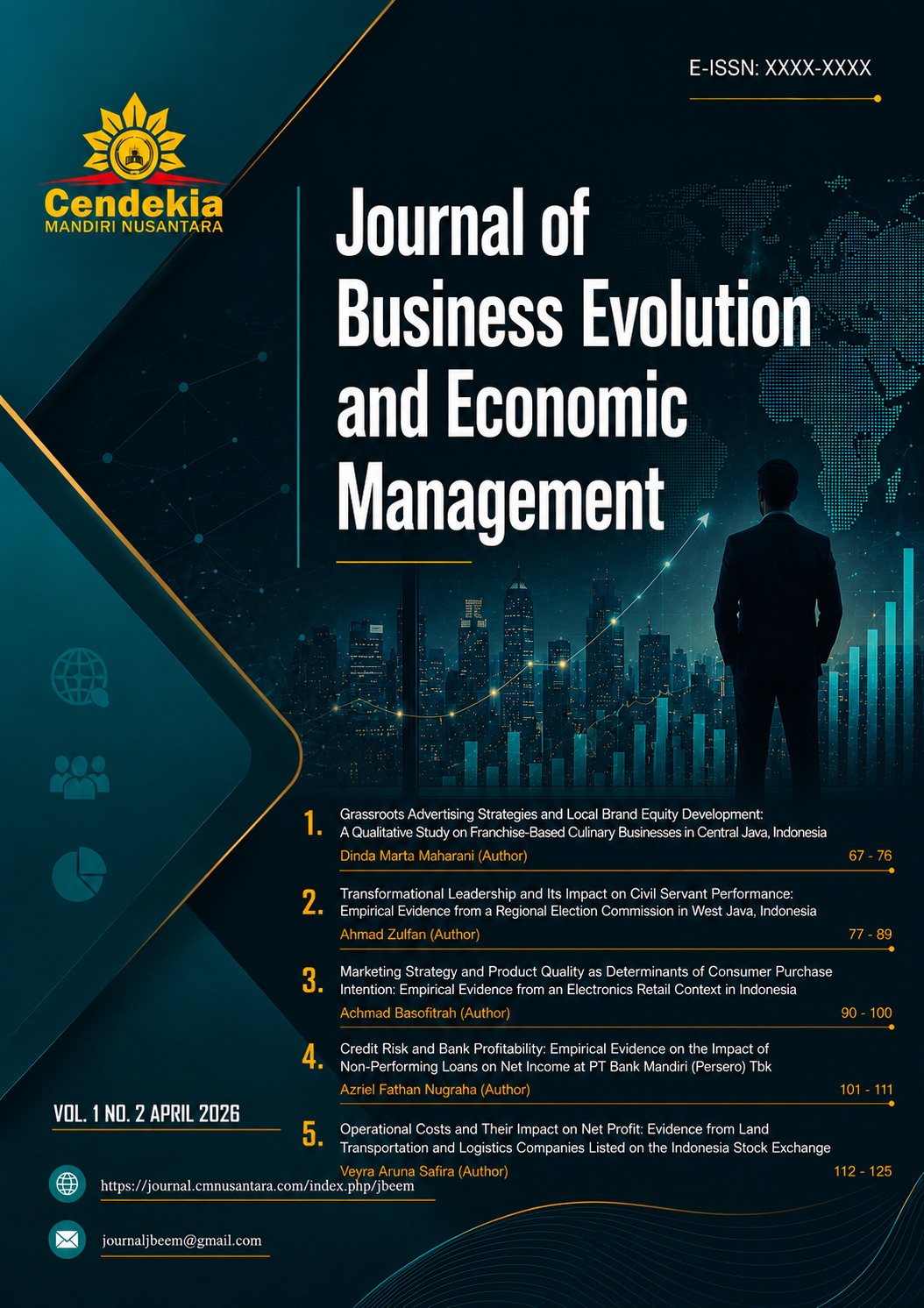
Transformational Leadership and Its Impact on Civil Servant Performance: Empirical Evidence from a Regional Election Commission in West Java, Indonesia
Keywords:
Leadership Effectiveness, Employee Performance, Public Sector, Regional Election CommissionAbstract
Effective leadership is widely recognized as a critical determinant of organizational performance, yet empirical evidence from public sector institutions in developing countries remains underexplored. This study examines the relationship between leadership quality and employee performance within a Regional General Elections Commission (KPU) office in Bandung Regency, West Java, Indonesia. Employing a quantitative approach with simple linear regression analysis, data were gathered from seventy-five civil servants selected through saturated sampling. Primary data were collected via validated questionnaire instruments, while reliability was confirmed through Cronbach’s Alpha testing. Statistical analysis revealed a strong positive and significant association between leadership and employee performance, supported by hypothesis testing outcomes. The coefficient of determination indicated that leadership quality accounts for approximately 92.7% of the variance in employee performance. These findings underscore the pivotal role of adaptive and participatory leadership styles in elevating the productivity and commitment of public sector employees. Practical implications for organizational development and leadership training programs in government institutions are discussed.
Downloads
References
Bandura, A. (1997). Self-efficacy: The exercise of control. W. H. Freeman.
Bass, B. M. (1985). Leadership and performance beyond expectations. Free Press.
Bass, B. M. (1999). Two decades of research and development in transformational leadership. European Journal of Work and Organizational Psychology, 8(1), 9–32. https://doi.org/10.1080/135943299398410
Bass, B. M., & Riggio, R. E. (2006). Transformational leadership (2nd ed.). Lawrence Erlbaum Associates. https://doi.org/10.4324/9781410617095
Borman, W. C., & Motowidlo, S. J. (1993). Expanding the criterion domain to include elements of contextual performance. in N. Schmitt & W. C. Borman (Eds.), Personnel Selection in Organizations (pp. 71–98). Jossey-Bass.
BPS (Badan Pusat Statistik) (2023). Jawa Barat dalam angka 2023. Badan Pusat Statistik Provinsi Jawa Barat.
Burns, J. M. (1978). Leadership. Harper & Row.
DeRue, D. S., Nahrgang, J. D., Wellman, N., & Humphrey, S. E. (2011). Trait and behavioral theories of leadership: An integration and meta-analytic test of their relative validity. Personnel Psychology, 64(1), 7–52. https://doi.org/10.1111/j.1744-6570.2010.01201.x
Fernandez, S., & Pitts, D. W. (2011). Understanding employee motivation to innovate: Evidence from front line employees in United States federal agencies. Australian Journal of Public Administration, 70(2), 202–222. https://doi.org/10.1111/j.1467-8500.2011.00726.x
Fiedler, F. E. (1967). A theory of leadership effectiveness. McGraw-Hill.
Greenleaf, R. K. (1977). Servant leadership: A journey into the nature of legitimate power and greatness. Paulist Press.
Grint, K. (2010). Wicked problems and clumsy solutions: The role of leadership. in S. Brookes & K. Grint (Eds.), The New Public Leadership Challenge (pp. 169–186). Palgrave Macmillan. https://doi.org/10.1057/9780230277953_11
Hair, J. F., Risher, J. J., Sarstedt, M., & Ringle, C. M. (2019). When to use and how to report the results of PLS-SEM. European Business Review, 31(1), 2–24. https://doi.org/10.1108/EBR-11-2018-0203
Heifetz, R., Grashow, A., & Linsky, M. (2009). The practice of adaptive leadership: Tools and tactics for changing your organization and the world. Harvard Business Press.
Hersey, P., & Blanchard, K. H. (1969). Life cycle theory of leadership. Training and Development Journal, 23(5), 26–34.
Hussain, A., Yousaf, M., Khan, M. A., Diah, M. L. M., & Shahbaz, M. S. (2019). The effect of transformational leadership on employee job performance through mediating role of organizational commitment in logistic sector of Pakistan. International Journal of Supply Chain Management, 8(4), 161–170.
Judge, T. A., & Piccolo, R. F. (2004). Transformational and transactional leadership: A meta-analytic test of their relative validity. Journal of Applied Psychology, 89(5), 755–768. https://doi.org/10.1037/0021-9010.89.5.755
Larasati, A. A., Zainal, V. R., & Nawangsari, L. C. (2022). Konsep penilaian kinerja karyawan berbasis akhlak. COMSERVA: Jurnal Penelitian dan Pengabdian Masyarakat, 2(6), 734–743.
Lianasari, M., & Ahmadi, S. (2022). Pengaruh kompetensi dan lingkungan kerja terhadap kinerja dengan motivasi kerja sebagai variabel intervening. Fokus Bisnis: Media Pengkajian Manajemen dan Akuntansi, 21(1), 43–59.
Liden, R. C., Wayne, S. J., Meuser, J. D., Hu, J., Wu, J., & Liao, C. (2021). Servant leadership: Validation of a short form of the SL-28. The Leadership Quarterly, 26(2), 254–269. https://doi.org/10.1016/j.leaqua.2014.12.001
Likert, R. (1961). New patterns of management. McGraw-Hill.
Mietzner, M. (2014). Indonesia’s decentralization: The rise of local identities and the survival of the nation-state. in H. Hill (Ed.), Regional Dynamics in a Decentralized Indonesia (pp. 45–67). ISEAS Publishing.
Mozaffar, S., & Schedler, A. (2002). The comparative study of electoral governance: Introduction. International Political Science Review, 23(1), 5–27. https://doi.org/10.1177/0192512102023001001
Muizu, W. O. Z., Kaltum, U., & Sule, E. T. (2019). Pengaruh kepemimpinan terhadap kinerja karyawan. Perwira: Jurnal Pendidikan Kewirausahaan Indonesia, 2(1), 70–78.
Northouse, P. G. (2021). Leadership: Theory and practice (9th ed.). SAGE Publications.
Osborne, S. P., & Brown, L. (2011). Innovation, public policy and public services delivery in the UK: The word that would be king?. Public Administration, 89(4), 1335–1350. https://doi.org/10.1111/j.1467-9299.2011.01932.x
Rahayu, R. S., Yulyasari, D., Tyvado, I. D., & Putri, A. A. (2023). Pengaruh gaya kepemimpinan transformasional dan lingkungan kerja terhadap strategi kinerja karyawan. BULLET: Jurnal Multidisiplin Ilmu, 2(1), 187–195.
Rahayuningsih, S. (2018). Pengaruh kompetensi, kompensasi dan motivasi terhadap kinerja karyawan. Prosiding SENDI_U 2018, 978–979.
Schermerhorn Jr., J. R., Osborn, R. N., Uhl-Bien, M., & Hunt, J. G. (2011). Organizational behavior (12th ed.). John Wiley & Sons.
Schneider, B., Ehrhart, M. G., & Macey, W. H. (2013). Organizational climate and culture. Annual Review of Psychology, 64, 361–388. https://doi.org/10.1146/annurev-psych-113011-143809
Sott, M. K., & Bender, M. S. (2025). The role of adaptive leadership in times of crisis: A systematic review and conceptual framework. Merits, 5(1), 2. https://doi.org/10.3390/merits5010002
Stogdill, R. M. (1948). Personal factors associated with leadership: A survey of the literature. Journal of Psychology, 25(1), 35–71. https://doi.org/10.1080/00223980.1948.9917362
Sugiyono, D. (2013). Metode penelitian pendidikan: Pendekatan kuantitatif, kualitatif dan R&D. Alfabeta..
Tarjo, T. (2020). Metode penelitian sistem 3x baca. Deepublish..
Tuffour, J. K., Gali, A. M., & Tuffour, M. K. (2022). Managerial leadership style and employee commitment: Evidence from the financial sector. Global Business Review, 23(3), 543–560. https://doi.org/10.1177/0972150919844395
Udayanga, M. (2020). The impact of transactional leadership on organizational productivity: A monographic study. International Journal of Multidisciplinary Current Educational Research, 2(5), 297–309.
van Dierendonck, D. (2011). Servant leadership: A review and synthesis. Journal of Management, 37(4), 1228–1261. https://doi.org/10.1177/0149206310380462
Wang, X., Lin, H., & Tang, P. (2022). Transformational leadership and employee performance: The mediating roles of cognitive trust and affective trust. Leadership & Organization Development Journal, 43(5), 796–813. https://doi.org/10.1108/LODJ-08-2021-0367
Wardhana, A., Trisavinaningdiah, A., Susiati, A., Setyaningsih, D., Wiliana, E., & Rachmawati, E. (2022). Manajemen sumber daya manusia. Widina Bhakti Persada.
Wright, B. E., Moynihan, D. P., & Pandey, S. K. (2012). Pulling the levers: Transformational leadership, public service motivation, and mission valence. Public Administration Review, 72(2), 206–215. https://doi.org/10.111/j.1540-6210.2011.02496.x
Yukl, G. (2020). Leadership in organizations (9th ed.). Pearson.
Downloads
Published
Issue
Section
License
Copyright (c) 2026 Ahmad Zulfan (Author)

This work is licensed under a Creative Commons Attribution 4.0 International License.
Authors who publish with this journal retain copyright and grant the journal the right of first publication with the work simultaneously licensed under a Creative Commons Attribution 4.0 International License (CC BY 4.0), which permits unrestricted use, distribution, reproduction, and adaptation in any medium, provided that appropriate credit is given to the original author(s) and the source of publication.